
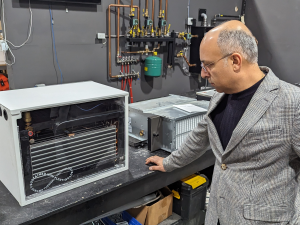
As someone deeply passionate about HVAC systems, my enthusiasm for the wave of innovative technologies emerging in recent years knows no bounds. I have been travelling across the United States and Canada meeting some incredible people and getting my hands on some truly innovative technologies. However, my recent introduction into phase change thermal batteries marks a standout moment in my career that truly signals a leap forward in the field of HVAC.
My journey into phase change material (PCM) batteries began about a year ago while researching dual-source heat pumps. I had recently installed an air-to-water in my home and specifically, I was exploring ways to design an efficient ground source heat pump for residential use that would allow me to install a water-to-water with a small loop without compromising performance or relying on the more traditional but highly effective district heating systems.
This led me to a fascinating patent overseas, detailing a dual source heat pump that incorporates phase change thermal storage. This discovery propelled me on a journey, connecting me with some brilliant minds.
So, what exactly is a phase change thermal battery? This battery harnesses the power to store latent energy with remarkable efficiency, leveraging the absorption or release of heat as it transitions between solid and liquid phases.
One-of-a-kind
The unique aspect of contemporary PCM batteries lies in their ability to undergo phase changes at non-industrial temperatures.
Innovations in the market now include products capable of phase-changing at temperatures under 138 F. This advancement opens the door for charging thermal batteries in residential settings, allowing the storage of usable heat that can be charged with boilers, water-to-water and air-to-water equipment and renewables.
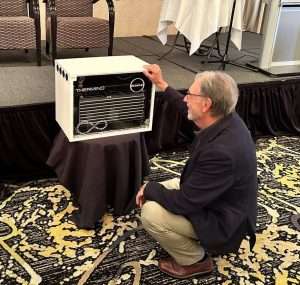
From my firsthand experiences visiting sites, I’ve observed PCM batteries in residential homes no larger than a small filing cabinet.
Despite their modest 80-litre physical size, these units effectively store the energy equivalent of 300 litres. This translates to the ability to store nearly four tons of capacity within a compact footprint. As cool as this is, the distinctive advantage of PCM batteries is their minimal standby losses, setting them apart from other energy storage methods by preserving energy more efficiently for extended periods.
PCM battery technology exhibits significantly reduced heat loss due to its compact size and the use of vacuum-insulated panels, a feature not typically found in conventional thermal storage methods.
Vacuum-insulated panels offer extremely high thermal resistance in very thin thicknesses (e.g., 0.5 to one inch). Recent measurements made at Queen’s University for NRCan have confirmed that the standby losses measured on a PCM battery were negligible over a few days.
Traditional vs. new batteries
When comparing a PCM battery to a traditional electrical battery, such as those used with solar photovoltaic systems for power storage, the advantages of PCM batteries are significant for several reasons. PCM batteries are considerably more cost-effective than their electrical counterparts. The ones I have seen are also free of moving parts, eliminating the need for maintenance, and don’t require special permits for installation. A PCM battery can be retrofitted into an existing home in less than an hour (something that is not achievable with traditional electrical battery storage).
The question then arises: how can we best utilise PCM batteries? One immediate application is harnessing solar PV systems not just for generating electricity, but also for producing usable heat. A small PCM battery can be fully charged in under five hours, storing a significant amount of thermal energy in a compact footprint. This stored energy can then be used in a variety of applications, including radiant floor heating and domestic hot water systems.
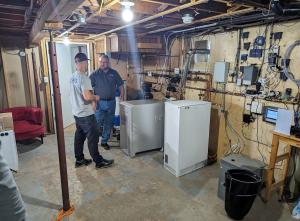
I made a visit to a residence last year where the owners had installed a PCM battery, linking it to a small solar PV array. This particular battery was equipped with a 2.8kW electric element that was charged by the PV system. Over two years, this setup provided the household’s domestic hot water, with the local utility company keeping track of its performance. The capacity of the PCM battery in this scenario matches that of an 80-litre hot water tank.
The PCM battery I’m currently examining in my live fire lab includes a dual pass heat exchanger, allowing for charging via both solar PV and solar thermal sources.
The aspect of PCM batteries that truly captivates me is their capability for load shifting. During a discussion with a colleague employed at a local utility, I explored the practical applications of a PCM battery. He quickly highlighted its effectiveness in transferring the timing of heating or the generation of domestic hot water to off-peak periods, thereby capitalizing on the considerably reduced energy costs during those times. The compact yet efficient nature of PCM batteries allows for the accumulation of a significant thermal energy reserve with barely any energy loss when not in use.
By charging these units overnight, when energy rates are at their lowest, and deploying the energy during high-demand periods, we unlock a strategy that not only optimises energy consumption but also competes favourably in cost against traditional fuels like natural gas. This innovative approach promises a shift towards more economical and efficient energy use.
Recharging at night
In my live fire lab, instead of utilizing solar PV or solar thermal systems, we are using a unique approach by charging our PCM battery using an air-to-water heat pump. This setup is part of a custom control strategy that enables us to explore a hybrid heating application.
The air-to-water heat pump, capable of delivering five tons of heating, charges the PCM battery during off-peak hours and when there is no need for heat in the home. On the coldest days, the battery serves as a secondary heating stage, utilizing the energy stored during off-peak periods.
A feature of our system is its automatic recharge mechanism; once the battery’s charge level falls to 40 per cent, it begins to recharge itself either through the air-to-water system or its integrated electric element.
While our goals include minimizing energy consumption, smoothing out grid demand, and reducing our carbon footprint, we prioritize maintaining occupant comfort above all else in the design of heating and cooling systems. This principle guides our experimental approach, ensuring that innovation in energy efficiency does not come at the cost-of-living comfort.
From an environmental perspective, the adoption of PCM batteries represents a significant step forward in reducing carbon emissions. By leveraging renewable energy and reducing reliance on fossil fuels for heating, these systems underscore a commitment to a more sustainable and environmentally friendly energy future.