
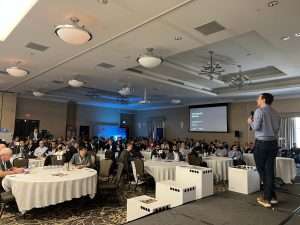
“Who is interested in learning about heat pumps?” asked Michael Ridler, owner of Eden Energy Equipment, to the full room of contractors, engineers, manufacturers, and developers at Eden Energy Equipment’s annual general meeting in Guelph, Ont.
Held at the Delta Guelph Hotel on Sept. 18, the event aimed to move the conversation forward and provide practical industry education focusing on the future of heating, cooling, electrification, and designing better building systems.
Front and centre of the conversation was phase change technology — literally and figuratively. Sitting in the best seats in the house, right in front of the main stage, were three solar thermal batteries. This was quite the efficient segue into one of the most common themes brought up during several of the presentations — electrification.
As always, when electrification is mentioned, it feels inevitable that the next talking point almost always shifts towards grid capacity. There remains to be quite a bit of anxiety regarding those in the industry. Or as Umar Waqas, VP of grid modernization at GrandBridge Energy, put it, “The elephant in the room is whether grid constraints are real.”
It is anticipated that by 2050, there will be an increase of 75 per cent on the grid. This is largely due to increases in the commercial and industrial sectors, including data centres. A grid investment across the country is needed. There has been a lot of good work conducted by our industry, but there needs to be more.
Peak demand is the constraint, and it will take a unified demand management approach to help mitigate the extent of the consequences. If nothing is done, then we are headed towards some scary times, but given how we are currently operating, we are headed in the right direction, reported Waqas.
This industry is moving in the right direction for more than just the electricity grid. There are positive strides in the number of homes making the switch towards heat pump technology. Homes are now being designed as a whole system, shared Scott Schrier, junior project manager of operations at Building Knowledge Canada. In addition, the number of options available to designers has increased.
Building a modern, highly efficient home will mean working together using an integrated design method — design, model, test, and label. “We know where we need to go and how fast. The question remains, what are we going to do about it,” shared Corey Diamond, executive director of Efficiency Canada. During his presentation, he supported the adoption of heat pumps, like the previous speakers. According to Diamond, heat pump adoption has increased six fold in recent years. He warned the audience that we shouldn’t fall prey to just slapping the cheapest system into a home. That won’t help anyone.
Several other sessions were held during the jam-packed day, including conversations about how builders are electrifying, avoiding design mistakes, and choosing the right HVAC solution for the project. Speakers included Robert Bean, ASHRAE distinguished lecturer, Leigh St. Hilaire, executive director at Volta Research, Patrick Marion, senior sustainability and procurement leader at Mattamy Homes, and Jeff Hammond, executive director of the International Ground Source Heat Pump Association (IGSHPA).