
By William Wu
For most plumbing and HVAC professionals, water treatment has traditionally been framed as a health or lifestyle upgrade — something customers ask for when they want better-tasting water or peace of mind. But in the field, water quality tells a very different story.
Poor water quality is one of the most overlooked drivers of callbacks, premature equipment failures, warranty disputes, and lost profit. Scale buildup, chemical degradation, and unstable feed water quietly erode system performance long before a visible failure occurs. By the time a contractor is called back, the damage is already done.
Most water treatment conversations focus on product specifications: micron ratings, flow rates, or contaminant reduction claims. While these metrics matter, they rarely address what contractors care about most — failures, labour time, and repeat service calls. A more effective approach shifts the question from “What does this filter do?” to “What problems does this water cause if left untreated?”
When viewed through that lens, water treatment becomes less about wellness marketing and more about risk management for plumbing systems. While there are many different problems that technicians will run into, there are four problems that contractors see every day.
Common callbacks
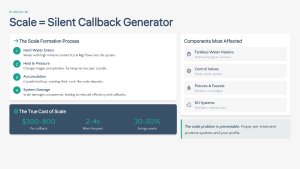
First is scale buildup, or rather, the silent callback generator. Hard water minerals such as calcium and magnesium precipitate under heat and pressure, forming rock-like scale inside pipes, valves, and heat exchangers. Over time, this buildup restricts flow, reduces heat transfer, and forces equipment to work harder than designed.
The true cost of scale is rarely limited to one repair. Scale-related callbacks often occur two to four times more frequently, with each visit costing hundreds of dollars in labour, parts, and lost opportunity.
Next is premature valve and seal failures. Chlorine and chloramine, essential for municipal disinfection, are aggressive oxidizers. Continuous exposure breaks down elastomers and plastics, causing seals to lose flexibility and crack prematurely. Valves, O-rings, diaphragms, and hoses are especially vulnerable, particularly in commercial systems that operate continuously and at elevated temperatures. Without proper protection, systems expected to last five to seven years may fail in two to three years.
Third on the list is tankless heater inefficiency. Scale acts as an insulator. In tankless water heaters, even a thin layer forces the unit to consume more energy to reach set temperatures. This leads to higher operating costs, frequent error codes, and shortened equipment lifespan, often blamed on the heater rather than the water feeding it.
Last is unstable RO performance. Reverse osmosis is often treated as a complete solution, but RO is a finishing step, not a standalone system. RO membranes are highly sensitive to chlorine, hardness, and sediment. When feed water quality fluctuates, so does TDS rejection, membrane life, and system reliability. Inconsistent feed water leads to fouled membranes, unpredictable water quality, and increased maintenance costs.
System thinking
Traditional repair thinking is reactive. A component fails, a call is made, and the issue is fixed in isolation. While necessary, this approach creates unpredictable schedules, emergency labour, and dissatisfied customers.
By contrast, system thinking focuses on preventing failures before it occurs. Instead of treating symptoms, contractors manage incoming water quality to protect every downstream component.
This shift offers tangible benefits, including fewer emergency callbacks, predictable maintenance schedules, longer equipment lifespan, and stronger customer trust and retention.
Effective water treatment isn’t about installing more filters; it’s about applying filtration with purpose. Modern systems typically serve three distinct roles.
First is the pre-treatment, which prepares incoming water by removing contaminants that cause damage, including sediment filtration, chlorine and chloramine reduction, and scale inhibition. Next is system protection. This safeguards high-value equipment, including valve seals and fittings, heaters, and RO membranes.
Lastly, modern systems service point-of-use optimization. Final polishing should be conducted based on application needs, including taste and odour control, TDS adjustment, and compliance or specialty requirements.
Contractors who integrate all three roles deliver more reliable systems than those who install filters as isolated components.
Matching filtration to the application
Different jobs demand different strategies. Restaurants prioritize scale prevention, taste consistency, and health compliance. High-capacity pre-treatment paired with RO creates reliability and opens the door to quarterly service contracts.
Coffee shops require precise TDS control for flavour and equipment protection. Small deviations in water chemistry can impact both product quality and machine lifespan. Office buildings value reliability and low maintenance. Long-life filtration systems with minimal service requirements support multi-year agreements and predictable revenue. The common thread is not the filter itself, but how well the system aligns with the application.
Even the best filtration strategy fails if installation is complex or time-consuming. Modern systems increasingly emphasize push-to-connect fittings, modular, stackable designs, and tool-free cartridge changes.
Reducing installation time by 60 to 80 per cent doesn’t just save labour, it allows contractors to complete more jobs per day while lowering the risk of leaks and callbacks.
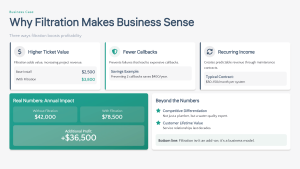
When applied correctly, filtration delivers measurable financial returns, including higher ticket values by integrating protection into base installs, fewer callbacks, saving hundreds or thousands annually, and recurring income through maintenance and filter replacement programs.
Beyond direct revenue, filtration positions contractors as water quality experts rather than emergency repair providers. That distinction increases customer lifetime value and long-term loyalty.
Water quality is not just a technical variable; it is a business variable. Technicians who treat filtration as a strategic tool, rather than an accessory, gain control over callbacks, warranties, and customer relationships. In today’s market, the most successful professionals are not simply installing equipment. They are managing systems, and water quality is where that management begins.