
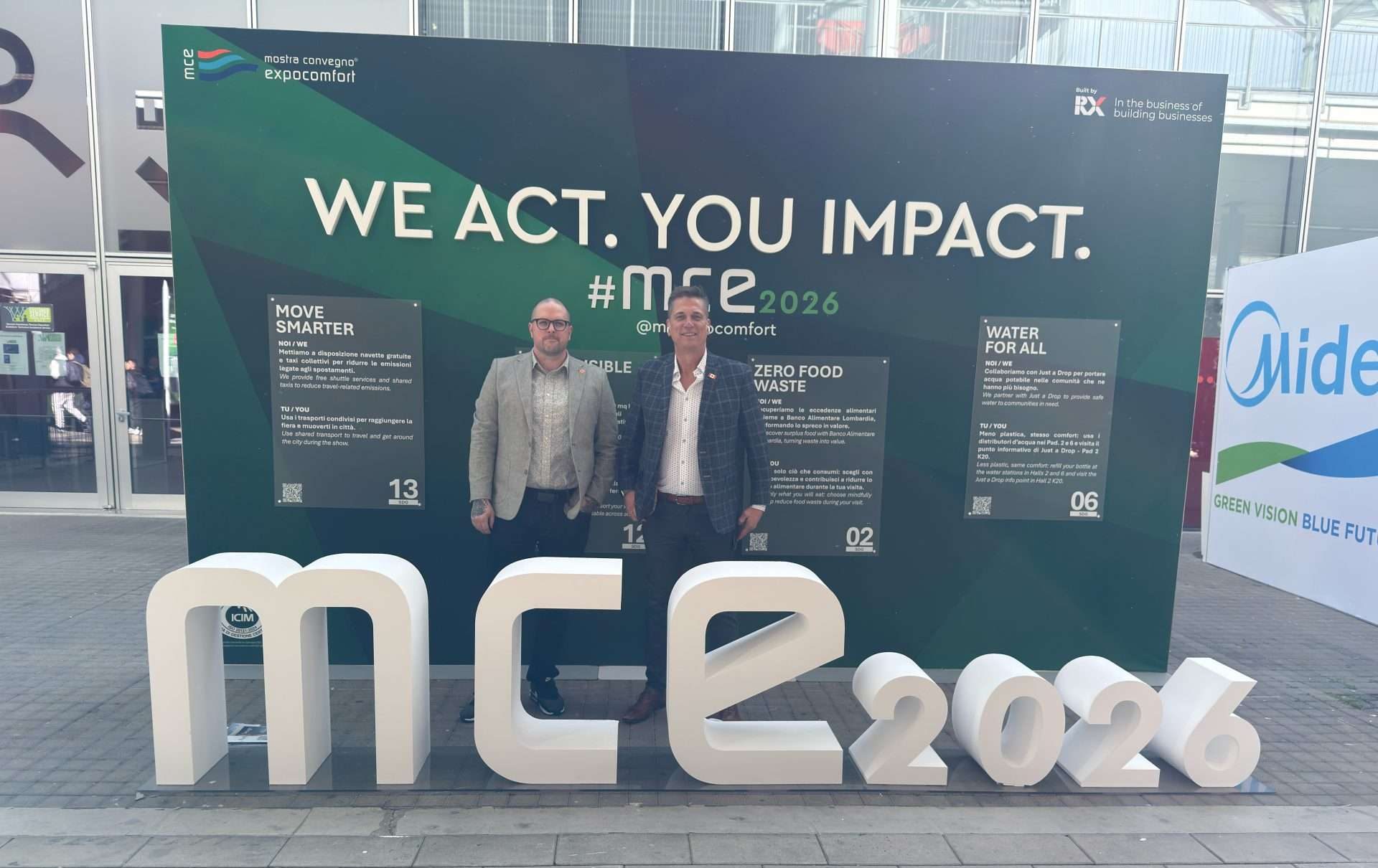
I’ll be honest, I was skeptical the first time someone told me I needed to go to another trade show. Another set of booths, another tote bag full of spec sheets I’d never read again. But Mostra Convegno Expocomfort (MCE) in Milan is genuinely built differently, and after this year’s show, I came back with the same feeling I had from MCE 2024; we are looking at where Canada’s plumbing and mechanical market is going to be in about a decade, and the Europeans are already living there.
That’s not a knock at our industry. It’s an observation. And I think it’s worth sharing with anyone who works in this trade and wants to stay ahead of what’s coming.
The single biggest takeaway from MCE 2026 is that air-to-water heat pumps are not an emerging technology in Europe. They haven’t been for years. Entire manufacturing booths, not corners of booths, entire booths, are built around these systems for residential and light commercial applications. Nobody over there is debating whether they make sense. That conversation happened, it ended, and they moved on to making them better.
Back home, we’re still largely tied to forced air furnaces, which is understandable. It’s what we know, it’s what builders spec, and it’s what homeowners expect. Air-to-air heat pumps have made meaningful gains, but nearly all of that product is manufactured overseas — in factories where labour inequity remains a serious concern. Our industry, along with the manufacturers in our market, have already provided the data necessary to make a compelling case for transitioning production to workers across Italy, Spain, broader Europe, and North America, where equitable labour standards are the norm. Air-to-water remains underutilized despite some clear advantages, especially when paired with radiant floor heating or low-temperature distribution.
Vast different conversation
What struck me at MCE was how refined air-to-water products have become, and the efficiency numbers back it up. Some of the systems on display are hitting a max COP of 8.9. For context, most air-to-air systems are topping out around 3.2. That’s not a marginal difference, that’s a fundamentally different conversation about operating costs and energy performance, and it’s a number worth putting in front of engineers and building owners whenever air-to-water comes up.
Pair that with thermal storage, and the conversation shifts again. These systems decouple heat generation from heat demand, allowing heat pumps and boilers to run at peak efficiency while banking that energy for when conditions are less favourable. Thermal storage takes it a step further: surplus energy captured during off-peak hours reduces grid dependence during peak demand, a critical advantage in both residential and commercial applications. The result is high-efficiency air-to-water systems paired with the ability to store and dispatch thermal energy on demand, fundamentally changing how we think about heating and cooling loads.
Shift in tech
What also struck me was how complete the packaged units have become. Integrated pumps, controls, expansion tanks, and backup heating all in a wall-mounted box with a touchscreen that adjusts performance based on outdoor temperature and energy pricing. These aren’t prototypes; they’re production units shipping in volume.
The good news for Canada: we already understand hydronics. The knowledge base exists in our trade. The transition to air-to-water isn’t starting from zero, it’s applying what we already know in a new direction. As electrification policies tighten and natural gas faces more regulatory pressure in certain provinces, I’d stop thinking of this as an alternative and start thinking of it as inevitable.
That said, let’s be straight about something: inevitable doesn’t mean unconditional, and anyone selling air-to-water systems without a serious conversation about backup heat is setting their customers up for problems.
Alberta and Saskatchewan are a different animal than coastal B.C. or southern Ontario. We’re talking about sustained design temperatures that will push any heat pump to its limits, and natural gas infrastructure that is well established, reliable, and not going anywhere soon. Heck, it runs most of the electrical distribution in those markets. Natural gas isn’t just a legacy technology we’re phasing out; it’s a necessary backstop. A high-efficiency condensing boiler or tankless water heater as backup and redundancy in an air-to-water system isn’t a compromise, it’s good engineering.
The hybrid approach for air-to-water as the primary system doing the heavy lifting through most of the heating season, paired with reliable gas backup for design day conditions, is the realistic path forward for our climate. It lets customers capture the efficiency gains of heat pump technology without betting the whole system on equipment performance at -30 C or colder. For specifiers and contractors in this region, that’s the conversation worth having. Not air-to-water versus gas, but air-to-water with gas as part of an integrated, resilient design.
Packaged mechanical systems were the thing that hit hardest on the show floor this year. Prefabrication in European mechanical systems isn’t a trend, it’s just how things are built.
I’m not talking about pre-assembled headers; I’m talking about complete mechanical rooms — pre-piped, pre-wired, pressure tested at the factory, delivered to site. Buffer tanks, hydraulic separators, and controls, all integrated. You’re not building a system onsite; you’re installing one that’s already been built and verified.
Realistic labour market
For anyone who’s tried to find a journeyperson who can properly commission a complex hydronic system lately, this should sound appealing. Skilled labour shortages are real and they’re not going away. Packaged and modular systems reduce complexity at the job site, reduce the opportunity for error, and improve consistency. The contractors and mechanical firms that get comfortable with this model early are going to have a meaningful competitive advantage as it gains traction here.
Here’s something I’ll say plainly: the Europeans do hydronic system design better than we do. Not in every case, but as a general rule, yes.
Pressure independent control valves (PICVs) are a good example. At MCE, they’re standard specification items, not upgrades. Nobody on that floor was treating them as a premium add-on. Their value is understood — consistent flow regardless of system pressure fluctuations, proper balancing without endless manual adjustment, better efficiency, and better comfort.
They’ve embedded the intelligence into the components and taken the variability out of the commissioning process.
In Canada, I still walk into plenty of jobs where the balancing approach is closer to “set it and hope.” It works often enough that people stick with it. But as energy codes tighten and building performance standards evolve, that approach has a limited future. Getting ahead of it now — specifying better components, designing smarter systems — is a conversation worth having with your customers, specifiers, and engineers.
Alongside PICVs, there’s a strong culture at MCE around measurement and verification. Energy meters, flow monitoring, and digital performance tracking are built in from day one, not retrofitted after the fact. This is coming to our market through code requirements, whether we drive it or not.
At MCE, the system doing the most interesting work in multi-zone applications isn’t VRF — it’s four-pipe fan coil systems paired with heat interface units (HIUs). The four-pipe approach gives you independent heating and cooling circuits serving the same terminal units, which means you’re not forcing a building into heating or cooling mode. You’re letting different zones do different things at the same time. In shoulder seasons, or in buildings with mixed load profiles like multi-family or mixed-use developments, that flexibility is genuinely valuable.
Modern approaches
What makes the European application particularly interesting is how it’s being paired with HIUs at the zone or suite level. An HIU sits between the central distribution system and the end user, measuring actual heating and cooling loads in real time and distributing energy accordingly. It’s not a simple control valve, it’s an active metering and management device that ensures each zone gets exactly what it needs, tracks consumption for billing or reporting, and feeds data back to the central plant for optimization.
Combined with an air-to-water heat pump as the central source, this creates a system that’s genuinely responsive, one that measures and reacts to what the building actually needs, rather than running on assumptions and schedules. That’s a different level of system intelligence than most of what we’re doing here right now.
In Canada, I’ve been fortunate enough to assist in the design, procurement, and installation of a development in southern Alberta involving these products, and I look forward to sharing more about that project down the line. Most of these applications have been strictly commercial and not always executed with this level of integration in mind. As multi-family density increases and building energy performance standards get tighter, the case for this kind of measured, zone-level distribution gets considerably stronger. The HIU piece in particular is worth paying attention to, as metered energy distribution at the suite level is already appearing in high-performance multi-family projects, and it’s going to become more common.
Canada is not starting from scratch. We have skilled tradespeople, solid hydronic fundamentals, and real momentum building around heat pump technology. The gap isn’t about capability; it’s about pace and integration.
MCE doesn’t show you what might be possible someday. It shows you what’s already normal somewhere else. And in my experience, “normal somewhere else right now” becomes “standard practice here in five to ten years” with a consistency that’s hard to argue with.
The only real question is how quickly we’re willing to move, and how ready we’ll be when the market asks us to.