
By Tyler Gamble
The beer scene has exploded across the country and now it seems as though there’s a new brewery on every street corner. Why is that? How are all these new breweries able to brew different types of beer and do it well? I thought only the Germans or Czechs could brew a good pilsner, or the English a good pale ale, or the Irish a good stout? What if I told you, it was their water, more specifically, what’s in their water!
Research into the chemistry of brewing beer, and the advancement of water treatment technologies over the past decades have enabled microbreweries to brew many different types of beer, consistently, without restrictions. What this also means for local plumbers and water treatment professionals is that there is a new market of knowledgeable people who need various types of plumbing equipment, including water treatment.
Steps of Brewing
In order to understand where water treatment experts can lend a hand in the brewing process, you first need to understand the process itself.
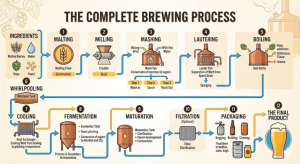
The image shows the steps involved in brewing beer. Brewing can be quite complicated, but we’re only going to focus on the areas where water plays a role. There are other areas where water is used within the brewing process, and we’ll speak to those as well. One item to consider: any water that is part of the final product will be very tightly controlled, and it is the goal of the treatment process to provide the brewer with as consistent water as possible.
The water used during the brewing process must start by being potable and follow the Guidelines for Canadian Drinking Water Quality. It must also be free from disinfectants like chlorine. However, being potable alone doesn’t make for good beer. Depending on the style (pilsner, lager, stout, IPA, etc.), the chemical composition of the water, at various points during the process, is tightly controlled. If the brewer is looking to brew an ale with a strong bitter flavour to it, then that brewer will be looking to a profile with higher sulfates, residual alkalinity, and calcium. Looking to brew a pilsner style lager? Then you would be looking at a profile lower in all those aspects.
What about a nice strong flavoured stout? Then you would ramp up the mineral mentioned again and then chlorides as well!
Water profile
The profile is the combination of the chemical composition of the water. In particular, brewers are most interested in the various levels of calcium, alkalinity, sulfates, chlorides, magnesium and pH. Other parameters of note include (but not limited to) that should ideally be eliminated or minimized as much as possible are iron, manganese, and sodium.
If it wasn’t apparent already, understanding and controlling the profile of the water is of utmost importance. This is where water treatment steps in. By treating the water with various technologies, you can help the brewer optimize their water profile for what they are wanting to achieve. We’ll speak to a few of those technologies.
Media filtration is the generic term we’ll apply to any filter that aims to remove the turbidity, or cloudiness from the water source. This term can also refer to single use cartridge filters as well. However, single use cartridge filters are generally not recommended. Breweries tend to use large volumes of water during the brewing process. These volumes range three to eight times the amount of beer brewed!
Every brewery on municipal water will want to remove the free chlorine levels in their water. This can be completed with the use of activated carbon filtration. Free chlorine will create various off flavour compounds that will adversely affect the taste of the beer. Not to mention, should the free chlorine make their way into the mash, it will likely form disinfection byproducts. Disinfection byproducts are compounds that are linked to various cancers, and are a regulated contaminant.
Ultraviolet disinfection
Ultraviolet (UV) disinfection is primarily used for water that have not been disinfected. These water sources are usually private wells owned by the brewery. Any bacteria that make their way into the brewing water can become involved in any of the processes and produce off flavours in the final product, or worse case, get someone sick.
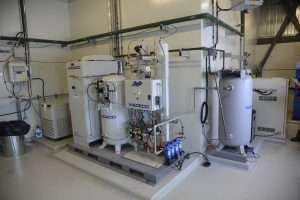
Reverse osmosis (RO) systems remove almost all of the mineral content from the water (typically better than 95 per cent). But if we think back to my earlier comment, brewers want minerals in their water, so why would you want to consider an RO system? The answer: consistency. Brewers, while they love to experiment with new styles of beer, also want to make sure that once they’ve figured out their recipe, they can make it over and over again, with very little deviation. To do that, they need the same mineral content in each batch. While that sounds simple, it’s not.
Larger municipalities can change the water source a building pulls from periodically. So, your municipal water source (and therefore water chemistry) can be different from day to day. That’s a big problem when you’re expecting water with low mineral content to brew your lager, and you get a profile more suited for stouts and ales. By removing the mineral content from the water, the brewer can then build the exact recipe they need that day for that brew by adding mineral salts (gypsum, calcium sulfate, Epsom salts, table salt, baking soda, chalk, etc.).
Water softeners
Softening the brewery water with water softeners is generally not recommended. Water softening is the process of exchanging hardness minerals (calcium, magnesium, iron, manganese, etc.) with sodium. While small amounts are desirable in brewing to help accentuate the sweetness of the malt, this quickly turns to a salty taste that is generally unappealing.
That being said, there are many areas where softening the water is desired. There’s way more that goes into brewing your favourite pint than you probably realized. Water quality is most likely the reason you may prefer one beer over another.