
By Michael Schaber
Click here to view the full presentation on “Water Softening as a Form of Water Treatment.”
I’ve been going into people’s homes for two decades and most homeowners have no idea what’s actually coming out of their taps. Water looks clean, it usually smells fine, but the evidence is right there crusted around the faucet, etched into the shower glass, and quietly building up inside the water heater where nobody can see it. It is good practice to learn to point that out the moment you walk in. That visible damage is your most powerful educational tool, and an educated customer is one who understands why they need what you’re about to recommend.
The first thing I tell every new contractor I work with is this: slow down before you start selling. The temptation is to walk in with a solution already in mind, but that’s a mistake that will cost you credibility and potentially cost your customer money they didn’t need to spend. Every home is different. Every water supply has its own profile. Your job before anything else is to understand what you’re actually dealing with.
Before you recommend a single piece of equipment, test the water. There is no shortcut around this step, and any contractor skipping it is cutting corners they shouldn’t be cutting. What you’re primarily looking for are two metrics: water hardness and total dissolved solids (TDS).
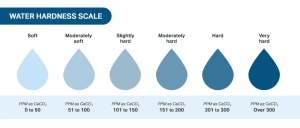
Hardness tells you how much calcium and magnesium are dissolved in the supply — you’re measuring in grains per gallon. Anything under one gpg is soft water and rarely a problem. Once you start seeing readings above seven gpg, you’re in genuinely hard territory, and above 10 gpg, you’ve got mineral buildup that is actively working against every appliance, fixture, and pipe in that home every single day. In many Canadian markets, particularly out west and through parts of the Maritimes, readings above 14 gpg are common. Know your regional baseline before you walk through the door.
Bigger picture
TDS captures the sum total of everything dissolved in that water: minerals, metals, salts, and trace chemicals. High TDS isn’t just a taste complaint. Elevated calcium and oxalate concentrations are clinically linked to kidney stone formation. Chronic high-mineral intake has documented associations with blood pressure elevation and cardiovascular stress. In more severe contamination scenarios, the research points to developmental concerns and longer-term health consequences. You’re not a doctor and you shouldn’t present yourself as one, but you do need to understand this context. It gives weight to the conversation and helps customers take the issue seriously rather than dismissing it as a cosmetic problem.
Also, test specifically for iron, lead, sulfur, and any other contaminants common to your service area. Municipal water and well water have entirely different profiles. A well in a rural area can throw up surprises that would never show up in a city supply; know before you recommend.
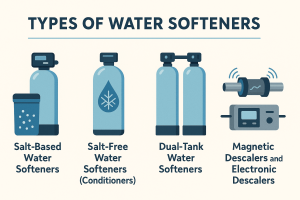
For hard water, my standard recommendation is a salt-based ion exchange softener. This is proven, well-understood technology and it works. The system uses resin beads to swap out calcium and magnesium ions for sodium or potassium, effectively neutralizing the hardness before the water reaches any fixture or appliance. For most households, a single-tank unit is entirely adequate. It regenerates based on actual water usage, which is efficient and avoids unnecessary salt and water waste. If your customer genuinely cannot afford any interruption to their soft water supply, spec a dual-tank system. One tank stays in service while the other regenerates — simple solution, higher ticket, and worth the conversation.
Common complaints
You will get pushback on salt; it happens on nearly every job. The customer asks whether they’re now drinking excessive sodium, and if you stumble on that answer, you lose confidence in the room. Here’s the reality: a single ounce of properly softened water contains approximately 0.15mg of sodium, which is the same amount of salt found in one slice of bread.
For the overwhelming majority of people, this is a complete non-issue. If you’re working with a customer on a medically restricted sodium diet, discuss potassium chloride as an alternative regenerant, or factor in a point-of-use reverse osmosis filter for their drinking water and address the concern directly, rather than side-stepping it.
Reverse osmosis belongs in almost every job you quote. An under-sink RO unit for the kitchen is a straightforward add-on that delivers measurable value. The membrane removes a wide range of contaminants that the softener doesn’t touch, including certain heavy metals and chemical residues. Flow rate limitations make whole-home RO impractical in most residential settings, but for drinking and cooking water it is the cleanest solution available. It also adds meaningful value to the overall sale without being a difficult conversation.
For customers who resist salt-based systems on principle, salt-free conditioners are worth knowing. Be precise about what they do: they don’t remove minerals. What they do is alter the physical structure of those minerals through a crystallization process, reducing their tendency to adhere to pipe walls as scale. It is a legitimate option for plumbing protection, but it is not softening in the traditional sense, and you should never present it as equivalent. Magnetic and electronic descalers work on a similar principle using electromagnetic fields. They have their applications, but I treat them as a secondary option rather than a primary recommendation.
Maintenance sets you apart
One of the biggest differentiators between contractors is customer callbacks. A softener requires ongoing attention and customers need to hear that from you upfront, not after something goes wrong.
Regeneration configuration matters: most modern systems trigger based on water usage and that’s what I prefer to set up. Fixed timed schedules can waste salt and water unnecessarily. Make sure the customer understands they can manually force a regeneration cycle if needed, and explain the basic indicators that the system may need attention.
Annual servicing is non-negotiable: calibrate the control head, clean the brine tank, and check the resin bed. Neglect those steps and performance will degrade gradually in a way that’s easy for the customer to miss until there’s a real problem. Build that annual visit into your service model. It creates recurring revenue, keeps systems running at peak efficiency, and keeps you in front of the customer once a year.
Most jobs close on economics once you lay it out clearly. Soft water means significantly less shampoo, conditioner, dish soap, and dishwasher detergent consumed per month. It eliminates the need for harsh descaling products on fixtures and shower surfaces. Water heaters and dishwashers run more efficiently and last longer when they’re not fighting mineral buildup year after year. The cost of replacing a water heater prematurely is a number that customers understand immediately.
Then there’s time. Customers who have been scrubbing hard water deposits off shower doors and faucet bases every weekend stop doing that. That is a quality of life change they feel immediately, and it’s one of the most effective things you can say in a sales conversation.
What you cannot do
Say this clearly and mean it: a water softener is not a medical device. Don’t make health claims you cannot substantiate. Don’t imply that your system will resolve a medical condition because it will not, and making that case will damage your reputation faster than any bad review. The industry has a history of overselling and customers are increasingly aware of it.
What you can honestly tell them is that properly treated water supports a healthier home environment, reduces chemical load from cleaning products, extends the life of their plumbing and appliances, and delivers better water at every tap. That is a strong, honest case. It doesn’t need embellishment.